

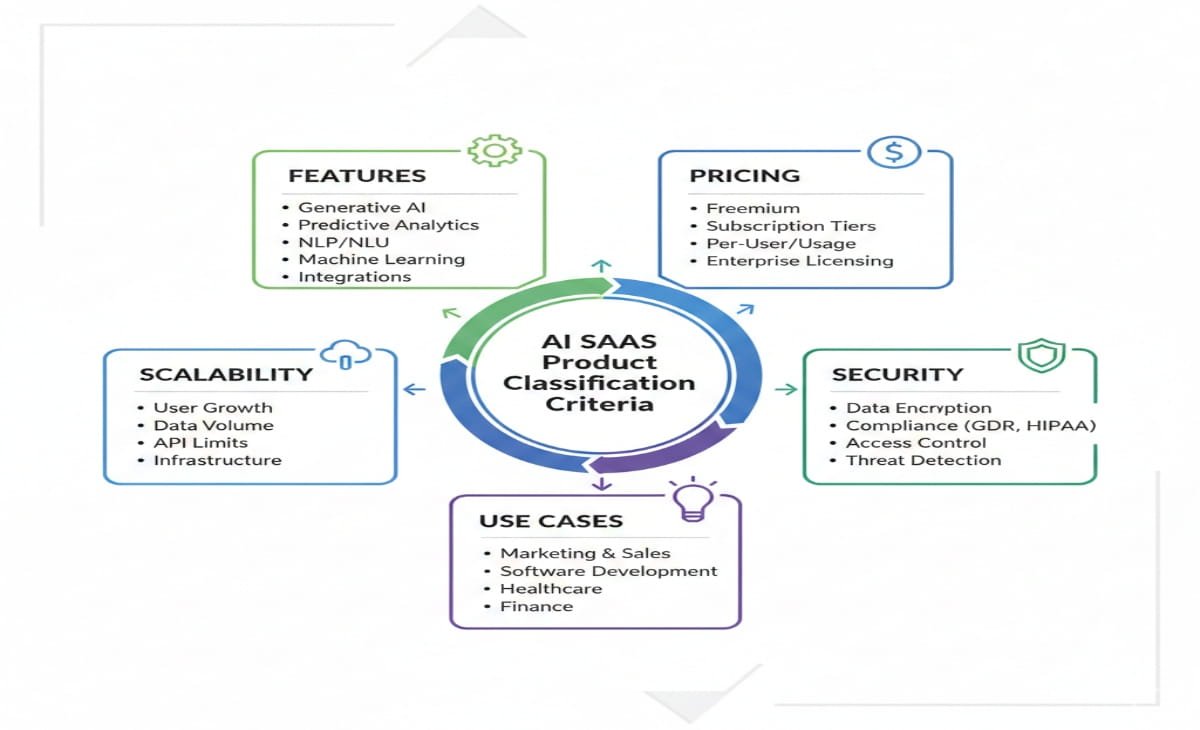

In today’s fast-moving digital landscape, Artificial Intelligence (AI) and Software as a Service (SaaS) have combined to create powerful tools that automate tasks, analyze data, predict outcomes, and even generate content. From customer service chatbots to predictive analytics dashboards, AI SaaS platforms are transforming how businesses operate.
But with thousands of solutions available, selecting the right one can feel overwhelming.
That’s where understanding AI SaaS product classification criteria becomes essential. Think of it like organizing items in a supermarket — when everything is categorized properly, it becomes much easier to find exactly what you need.
This guide breaks down the key classification criteria in simple, practical terms so you can evaluate AI SaaS tools with clarity and confidence.
What Is an AI SaaS Product?
An AI SaaS product is software delivered over the internet that includes built-in artificial intelligence capabilities.
Instead of installing software locally, users access it via a browser or app while AI works behind the scenes to improve efficiency and decision-making.
Common AI Technologies Used
- Machine Learning (ML) – systems learn from data patterns and improve predictions
- Natural Language Processing (NLP) – enables chatbots, voice assistants, and text analysis
- Computer Vision – image recognition and visual analysis
- Generative AI – creates text, images, audio, or code
- Predictive Analytics – forecasts trends and outcomes
These tools help organizations work faster, reduce costs, and make smarter decisions.
Why Classifying AI SaaS Products Matters
Imagine comparing a sports car with a delivery truck — both are vehicles, but built for different purposes.
Similarly, comparing AI tools without classification leads to confusion.
Classification helps you:
✅ Choose tools aligned with your business needs
✅ Compare features and pricing fairly
✅ Understand capabilities and limitations
✅ Ensure compliance and data security
✅ Avoid paying for unnecessary features
Core AI SaaS Product Classification Criteria
Below are the most important criteria used to categorize and evaluate AI SaaS products.
1. Business Function
The most practical classification method is based on what the software does.
| Function | Example Use Cases |
| Marketing & Sales | lead scoring, content generation, campaign optimization |
| Finance & Accounting | fraud detection, expense automation, forecasting |
| Customer Support | chatbots, ticket automation, sentiment analysis |
| Human Resources | resume screening, employee analytics |
| Operations & Supply Chain | demand forecasting, logistics optimization |
Tip: Start with your biggest operational pain point.
2. Type of AI Technology Used
Each product relies on different AI capabilities.
- Machine Learning → fraud detection, recommendations
- NLP → chatbots, transcription, sentiment analysis
- Computer Vision → quality inspection, facial recognition
- Generative AI → content, design, coding assistance
- Reinforcement Learning → decision optimization systems
Understanding the technology helps you evaluate accuracy, cost, and training needs.
3. Industry Focus (Vertical vs Horizontal)
Some tools are designed for specific industries.
Industry-specific (Vertical AI)
- Healthcare diagnostics
- Legal research automation
- Retail inventory forecasting
Cross-industry (Horizontal AI)
- writing assistants
- productivity tools
- CRM automation
Tip: Choose industry-specific solutions when compliance or specialized workflows matter.
4. Level of Automation
AI tools differ in how much human involvement they require.
- Fully autonomous – runs with minimal supervision
- Human-in-the-loop – requires approvals or review
- Assistive – provides insights but humans decide
In finance, healthcare, and legal fields, human oversight is often essential.
5. Deployment Method
Where your AI SaaS runs affects security and accessibility.
- Public cloud (multi-tenant) – standard SaaS delivery
- Private cloud – greater control and security
- On-premise deployment – full data ownership
- Hybrid models – combine cloud and local systems
Organizations with strict data policies often prefer private or hybrid setups.
6. Customization & Model Training
AI SaaS tools vary in flexibility.
- Pre-trained models – ready to use immediately
- Custom-trained models – trained on your business data
- Configurable workflows – adaptable without coding
Custom training improves accuracy but may require technical expertise.
7. Integration & API Ecosystem
Modern software must integrate smoothly with existing tools.
- Standalone platforms
- API-first tools for embedding AI capabilities
- Plug-and-play integrations with CRM, ERP, and productivity tools
Tip: Confirm compatibility with systems like Slack, CRM platforms, and data warehouses.
8. User Interface & Accessibility
Usability impacts adoption and productivity.
- No-code dashboards for business users
- Developer-focused tools with SDKs and scripting
- Chat-based interfaces for intuitive interaction
Choose interfaces that match your team’s skill level.
9. Pricing Model
Understanding pricing prevents unexpected costs.
- Freemium – basic features free
- Subscription plans – monthly or annual billing
- Usage-based pricing – pay per request or data processed
- Enterprise pricing – custom plans with support and SLAs
Always check for hidden fees like usage overages or onboarding costs.
10. Compliance, Ethics & Data Governance
AI must operate responsibly and securely.
Look for:
- Data privacy protections
- Regulatory compliance (GDPR, HIPAA, SOC 2)
- Bias detection and transparency
- Explainable AI outputs
This is especially critical for regulated industries.
Step-by-Step: How to Choose the Right AI SaaS Product
- Define your objective — identify the problem you want to solve
- Match business function — select tools aligned with your workflow
- Understand the AI technology — ensure it fits your use case
- Check integrations — confirm compatibility with existing systems
- Evaluate data handling — know where and how data is stored
- Assess automation level — balance efficiency with oversight
- Review pricing structure — align with your budget and scale
- Verify compliance & security — protect your business and customers
Final Thoughts
Selecting an AI SaaS tool doesn’t have to be complicated. By understanding these classification criteria, you can evaluate solutions logically instead of relying on marketing claims.
The right AI SaaS product is more than software — it’s a strategic investment in efficiency, scalability, and smarter decision-making.
The best technology doesn’t demand attention — it quietly improves everything around it.
Use this guide as your compass to navigate the growing AI SaaS landscape and choose solutions that truly support your goals.