

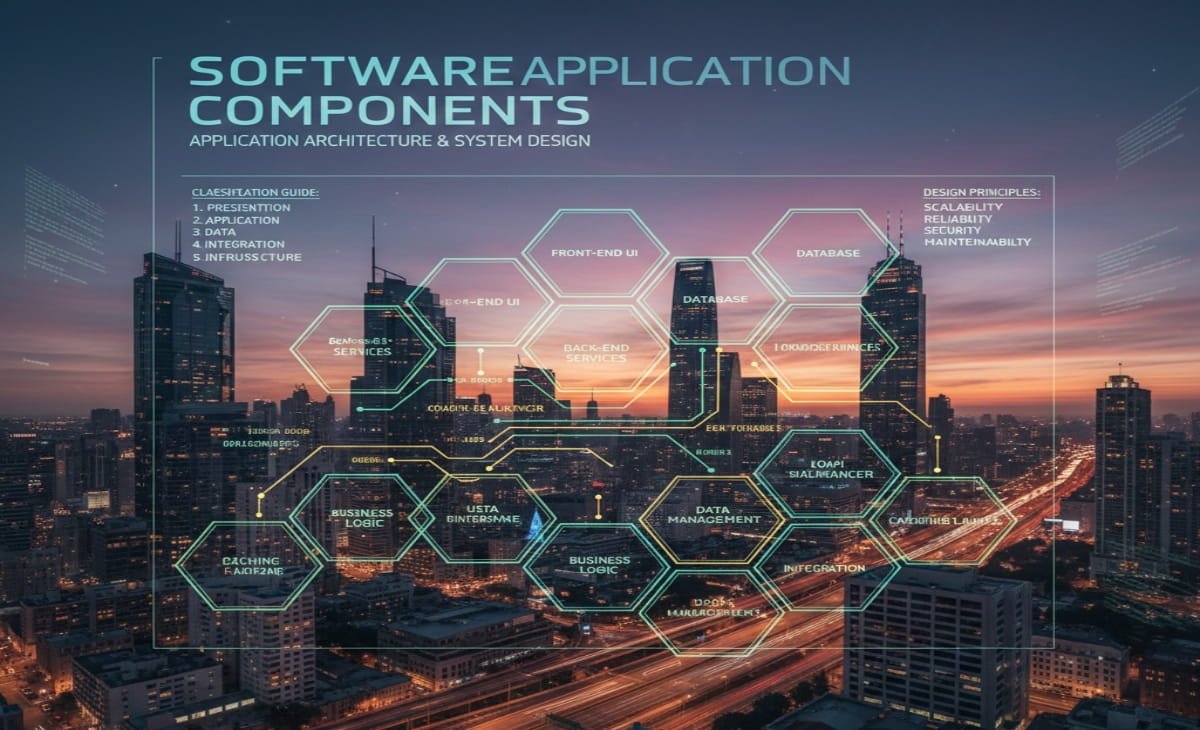

Understanding how to classify software applications components is a fundamental concept in computer science, software engineering, and information technology. Proper classification helps developers, students, architects, and IT professionals design scalable systems, improve maintenance, enhance security, and make informed licensing and deployment decisions.
What Does “Classifying Software Applications Components” Mean?
Classifying software applications components refers to organizing software and its internal parts based on function, role, architecture, domain, platform, and licensing model.
This classification answers key questions such as:
- What type of software is it?
- Which component handles user interaction?
- Where does data processing occur?
- Who uses this software?
- How is it licensed and distributed?
- Which industry or domain does it serve?
By breaking software into categories and components, developers can design systems that are easier to understand, build, secure, and maintain.
1 Main Classification of Software
At the highest level, software is divided into three major categories:
| Category | Purpose | Examples |
| System Software | Manages hardware and system resources | Windows, Linux, macOS |
| Application Software | Performs user-oriented tasks | MS Word, Chrome, Photoshop |
| Programming Software | Used to create other software | VS Code, Eclipse, GCC |
Each category serves a distinct role in the computing ecosystem.
2 Components of a Software Application
How to Classify Software Applications Components consists of multiple interconnected components. These components are classified during system design to ensure modularity and scalability.
🔹 1. User Interface (UI) Component
- Screens, buttons, forms, menus
- Web pages or mobile app layouts
- Handles interaction between users and the system
Example: Login screen of a mobile banking app
🔹 2. Business Logic Component
- Core rules and decision-making logic
- Handles calculations, workflows, and validations
Example: Interest calculation in banking software
🔹 3. Data Access Component
- Manages communication with databases
- Performs data retrieval, insertion, and updates
Example: SQL queries or ORM layers like Hibernate
🔹 4. Database Component
- Stores structured or unstructured data
- Can be relational or NoSQL
Examples: MySQL, PostgreSQL, MongoDB
🔹 5. Integration Component
- Enables interaction with external systems
- Uses APIs and third-party services
Examples: Payment gateways, cloud storage APIs
🔹 6. Security Component
- Authentication (login systems)
- Authorization (role-based access)
- Encryption and data protection
🔹 7. Configuration Component
- Environment variables and settings
- System preferences and deployment configs
3 Classification of Application Software
Application software is further categorized based on purpose and usage:
| Type | Description | Examples |
| Productivity Software | Improves efficiency | MS Office, Google Docs |
| Business Software | Manages enterprise processes | ERP, CRM |
| Educational Software | Learning and training | Moodle, Duolingo |
| Multimedia Software | Media creation and playback | Photoshop, VLC |
| Communication Software | Messaging and meetings | Zoom, Slack |
| Entertainment Software | Games and streaming | Steam, Netflix app |
4 Software Application Domains (7 Major Domains)
In software engineering, applications are often grouped into domains:
- System Software Domain – Operating systems, drivers
- Business Information Systems – ERP, accounting systems
- Engineering & Scientific Software – MATLAB, simulation tools
- Embedded Software – IoT devices, appliances
- Web Applications – E-commerce platforms, portals
- AI & Data Science Software – Machine learning platforms
- Mobile Applications – Android and iOS apps
Each domain has unique requirements, risks, and development practices.
5 Classification of Software Based on License
Software can also be classified by licensing model, which affects cost, usage rights, and distribution.
| License Type | Meaning | Examples |
| Open Source | Free with source code access | Linux, WordPress |
| Proprietary | Paid, closed source | Windows, Adobe |
| Freeware | Free to use, limited rights | Skype |
| Shareware | Trial-based software | WinRAR |
| SaaS (Subscription) | Cloud-based with recurring fees | Salesforce |
6 System Software Classification
System software ensures that hardware and applications function correctly.
It includes:
- Operating Systems – Windows, Linux
- Device Drivers – Printer, graphics drivers
- Utility Software – Antivirus, disk cleanup tools
- Firmware – BIOS, embedded system firmware
7 Ways to Categorize Application Software
Application software can be classified based on:
- Function (business, education, entertainment)
- Platform (web, desktop, mobile)
- License (open source, SaaS)
- Industry (healthcare, finance)
- User type (enterprise vs individual)
8 Software Engineering Courses Where Classification Matters
Software classification is a core topic in:
- Software Architecture
- System Design
- Requirements Engineering
- DevOps Engineering
- Cloud Computing
Understanding these concepts strengthens both academic learning and professional practice.
9 Why Software Classification Is Important
Proper software classification helps with:
✔ Better system design
✔ Improved security planning
✔ Accurate cost estimation
✔ Licensing compliance
✔ Easier software maintenance
✔ Clear career learning paths
Final Thoughts
Learning how to classify software applications components provides a strong foundation in software engineering, system architecture, and IT management. Whether you’re a student, developer, or IT professional, understanding these classifications helps you analyze, design, and manage modern software systems effectively.
Mastering software classification isn’t just academic—it’s a practical skill that shapes better systems, smarter decisions, and stronger technical careers.
FAQs
What are the components of a software application?
User interface, business logic, database, data access, security, integration, and configuration components.
What are the main classifications of software?
System software, application software, and programming software
What are the seven software application domains?
System, business, engineering, embedded, web, AI/data science, and mobile.
How is software classified by license?
Open source, proprietary, freeware, shareware, and SaaS.